
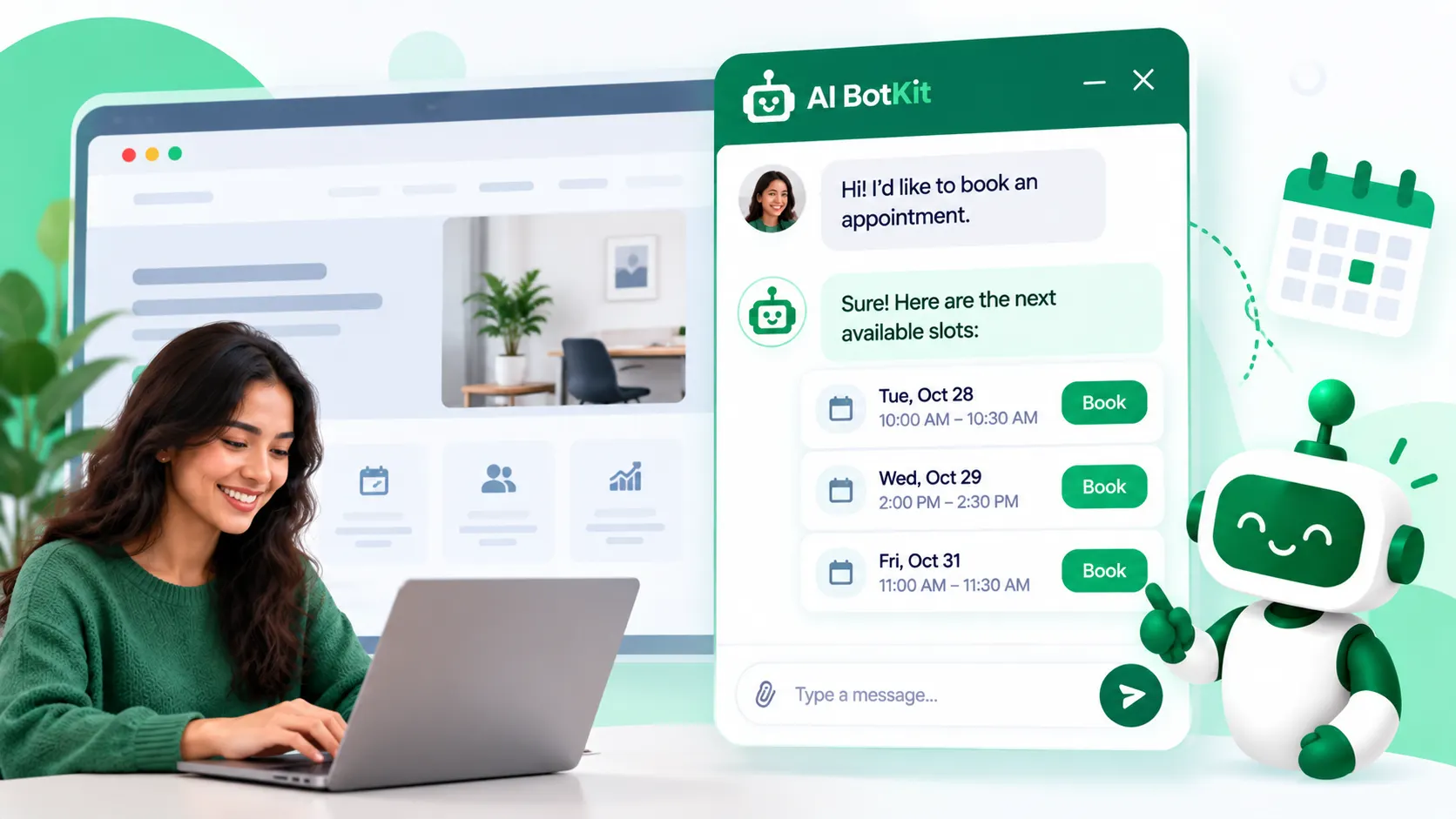
An appointment booking chatbot is a website assistant that answers visitor questions, asks a few qualifying questions, and offers real calendar slots at any hour. For AI appointment scheduling to work, it has to behave like a lead qualification chatbot first and a calendar tool second.
Picture a visitor on your site at 9 pm. They want to know whether you can see them Thursday afternoon. Nobody is online, so they close the tab and message someone else. That is the problem a booking chatbot solves.
Why does a 9 pm enquiry turn into a lost booking?
Interest cools fast, and speed is the part you can control. A Harvard Business Review study by Oldroyd, McElheran and Elkington audited 2,241 US companies by sending each a test lead. Companies that tried contact within an hour were nearly seven times more likely to qualify the lead than those that waited one more hour. The full article is listed in the BYU ScholarsArchive.
One caution: those firms were larger sales teams, not a two-chair salon. But the pattern holds for any business with an enquiry form. The longer someone waits, the less likely they are to book.
What does an appointment booking chatbot actually do?
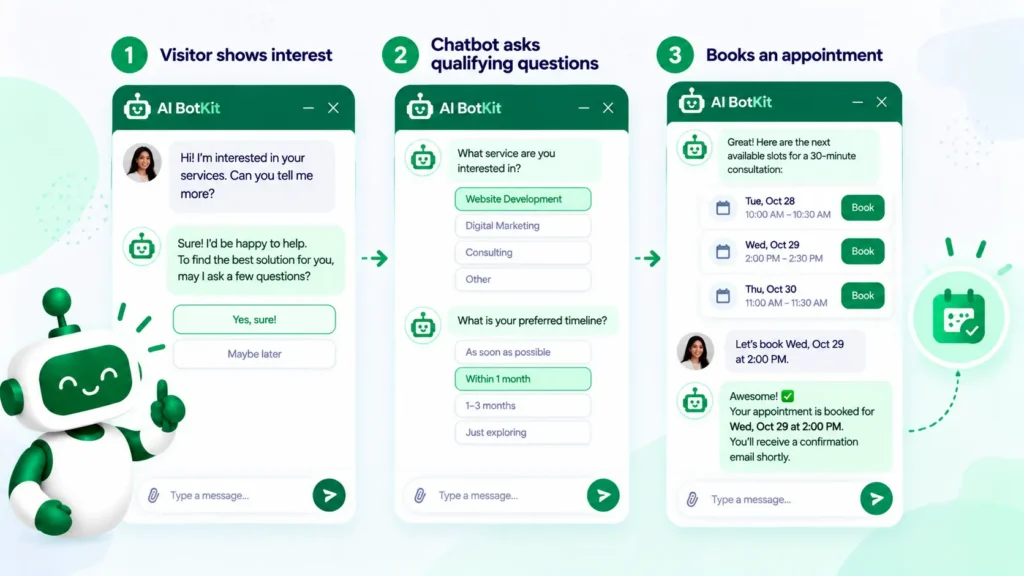
It does three jobs in one conversation: answer, qualify, then book or hand off.
- Answer: it replies to the questions people ask before booking, such as price, location and what to bring.
- Qualify: it asks the few things you need to know before a slot makes sense.
- Book or hand off: it offers a time, or passes the conversation to a person with context.
What does “trained on your own content” mean?
It means the bot answers from the pages, PDFs and documents you give it, not from general internet knowledge. That is why it can say your Saturday hours correctly. It also means the bot is only as good as your content. If your pricing page is out of date, so are its answers.
When is a simple rule-based flow enough?
If you offer one service with fixed times and no pre-booking questions, a button-driven flow or a plain booking link may be all you need. An AI bot earns its place when visitors ask varied questions before they commit.
How should the bot qualify a visitor before offering a slot?
Ask only what changes the appointment. Every extra question loses some visitors, so each one should decide the service, the length of the slot, or who should take it.
Which questions are worth asking?
Start with what service they need and when they are free. Then ask for a name and a way to reach them. Leave anything long, such as medical history or detailed briefs, to a form after the booking.
What does this look like for different businesses?
| Business | Qualifying questions worth asking | Why it matters |
|---|---|---|
| Clinic or practice | New or returning patient? Type of visit? | Sets slot length and who sees them |
| Salon or studio | Which service? Any preferred stylist? | Services take different amounts of time |
| Consultant or agency | What are you trying to solve? Rough timeline? | Filters time-wasters before a call |
How does booking work without double bookings?
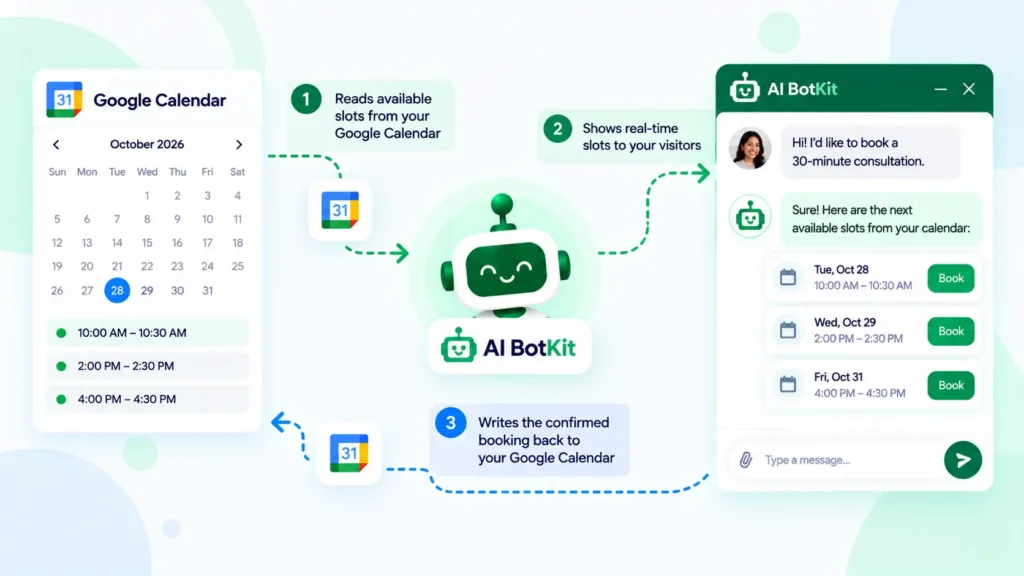
Your calendar should stay the single source of truth. The chatbot should read your real availability and write confirmed bookings back to it. It should never keep its own separate list.
What happens when the bot offers a time?
The bot checks open slots in your calendar, offers a few, and confirms the one the visitor picks. If the visitor changes their mind, the calendar updates, not a copy of it.
How does this work with AI BotKit?
At AI BotKit, we connect the chatbot to tools like Google Calendar and Google Meet through our Advanced AI Automation services, so booking happens inside the chat window. It is a set-up service today, not a one-click switch. We also have a native Meeting Broker feature coming soon, and we’ll update this post when it is live.
Where does a human still need to step in?
A good booking bot knows when to stop. Unusual requests, complaints and anything sensitive should go to a person.
What happens when the bot doesn’t know?
When a question falls outside what the bot was trained on, a well-set-up bot says so instead of guessing. At AI BotKit, we let you write the fallback message, for example offering to connect the visitor with someone, and the bot can ask for contact details.
How does a handover work?
We pass the conversation to your team with its full context, so the visitor doesn’t repeat themselves. Decide in advance who receives it and how quickly they will reply.
What about visitor data?
Visitors will share names and contact details. Tell them how you use those details, and check where your chatbot provider stores conversations before you go live. This post can’t tell you what your local privacy rules require.
Which setup fits your business?
Pick the lightest option that solves your actual problem.
| Approach | Best for | Trade-off |
|---|---|---|
| Booking link inside the chat | One service, fixed hours | No qualifying, no questions answered |
| Scheduling tool with a chat widget | Simple appointment types | Limited answers to pre-booking questions |
| AI chatbot with calendar integration | Varied questions before booking | Depends on good content and a clean calendar |
| Done-for-you setup | No time to configure it yourself | Costs more than doing it yourself |
How do you set one up in five steps?
- List your appointment types. Note length, who handles each, and any rules, such as no same-day bookings.
- Write your qualifying questions. Keep to three or four, each tied to a decision.
- Gather your content. Collect pricing, hours, policies and FAQs as pages, PDFs or documents.
- Train the bot and connect your calendar. Test with real questions, including awkward ones.
- Set the handover rules. Decide who is notified, how, and when a person takes over.
Checklist: is your business ready for a booking chatbot?
- My opening hours and prices are written down in one up-to-date place.
- My calendar shows real availability, with no hidden personal blocks.
- I know which two or three questions I need answered before a booking.
- Someone is named to receive handovers and reply within a set time.
- I’ve tested what the bot says when it doesn’t know an answer.
If you ticked fewer than four, fix those first. A chatbot will expose gaps in your information, not cover them.
FAQ
Can an AI chatbot book appointments or schedule meetings?
Yes, when it is connected to your calendar. With AI BotKit, this is set up through our Advanced AI Automation services using tools like Google Calendar and Google Meet.
What happens if the chatbot doesn’t know the answer?
It shouldn’t guess. It shows a fallback message you’ve written and can ask the visitor for contact details so a person can follow up.
What is human handover?
It is when the chatbot passes a conversation to a person on your team, with the earlier messages attached. The visitor doesn’t have to repeat what they already said.
If your enquiries pile up after hours, start by setting up your qualifying questions on our free plan and ask us about calendar booking when you’re ready.